The online French Quarter Journal published a story On the Origin of Jackson Square Artists: “They were a rowdy bunch” and I immediately thought of my father, Sidney J. Folse, Jr. A senior architect at the prominent local firm of Curtis & Davis, from the age before computer driven design when architects had to draw and color renderings, he took up painting in midlife and announced his retirement goal to hang his paintings in the Square.
Sadly early-onset Parkinson’s robbed him of a steady brush hand and his dream.
He was already a bit of a character by that point in life, with his Basque beret, guayaberas and goatee at a time when professional men were clean shaven. I credit his maiden aunts Gert and Sadie who lived in the street-fronting apartment at 824 Royal Street (later Hové Parfumuer) through the peak years of the post-War bohemia. They were contemporaneous with Gypsy Lou Webb who lived in the same block. They were not your typical maiden aunts, but filled ashtrays with Parliaments and took their cocktails every evening.
He was still clean shaven when I was very young, and a nationally prominent expert on correctional architecture: courthouses, jails and prisons. His first solo job was a cafeteria at Angola State Prison, which shares the Gaudiesque flowing roof of the Rivergate, and somehow he was pigeonholed; not unhappily, because he prospered. He built an exceptional midcentury modern house at 17 Egret Street, sent his kids to expensive Catholic schools and staged weddings for his daughters appropriate to his place.
Still, something clicked in the late 1960s. First the beard, then the beret and guayaberas. He took over my eldest sister’s room after she was married for his studio, with the afternoon light unobstructed by the large oaks on the eastern side of the house. With his daughters married and his sons approaching manhood, I think he felt free to fully be himself, the nephew of Gert and Sadie, a graduate of the 800 block of Royal. He took an interest in some of the more outré music coming out of my room: Todd Rundgren’s A Wizard/A True Star, the more symphonic and big band Frank Zappa, early seventies jazz fusion. The man who thought he would be a sign painter in his youth, who instead became a modernist commercial architect who admired both brutalism and Gaudi, was becoming an artist.
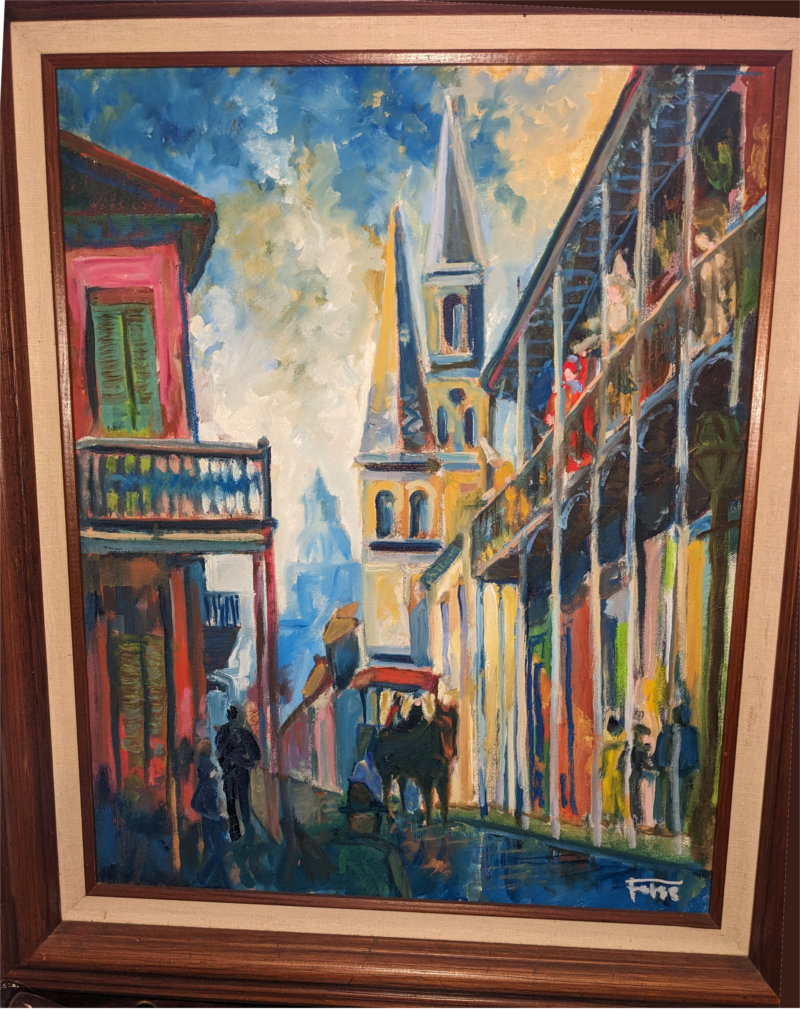
This painting I think of as an audition for the Square as he knew it from the 1940s through the 1960s and not far off what some paint today. The sharp edges of the renderings he was taught to make are softened, likely in acknowledgement of Impressionism, but to me it captures the sultry atmosphere of the Quarter.
His dream of the square was also of the time of the portraitists. He was still working on that aspect of his art. His renderings of family are Ok but perhaps not up to those who made their living paints tourists on the Square. Still, this self-portrait is frighteningly spot on. It’s the living man, with me and my descendants forever.

I often think of my father’s emergence from the responsible, respectable Lake Vista nouveau riche into an always suppressed artist late in life. I walked a similar path. I not only visited with my great aunts as a child, I escaped to the Quarter whenever I could from an early age. I had a brief interest in magic, and could take the bus from the lake to the CBD magic store, then wander the Quarter. (Yes 12 year-olds were allowed such freedom once). In college when I wasn’t in class I was visiting my girlfriend at her job at Café du Monde, and browsing all the used book stores and looking into galleries. It was in those stores I found my foxed first edition hardcover of the City Lights collection of Garcia Lorca, and picked up a red leather bound 32mo book of Shakespeare’s sonnets from a broken set in that size.
After college I was not a bohemian but a Quarter Rat, an habitué of The Abbey in its Betz Brown golden years with my thoroughly alcoholic partner. We were not complete wastrels . I won a couple of journalism awards, and remember the election night of 1984, arriving at the Abbey around 1:30 am. I had convinced the editor and publisher to hold the presses for Sunday’s edition, and I organized comprehensive coverage of the West Bank Jefferson elections. I drove back (unwisely) around 4 am for fresh copies from Gretna. We kicked the Times-Picayune’s ass in local coverage. Marianne was the right-hand woman of a fellow high up in the Morial administration. The words high-functioning come to mind.
After those years, when I followed the US Senate candidate whose campaign I had joined to Washington, D.C., I met an entirely sensible woman from North Dakota by way of Notre Dame. After our daughter was born, we moved first to a small town in rural northwest Minnesota where our son was born, then to Fargo, North Dakota. I had escaped journalism and politics (mostly), and led a quiet and decidedly uncreative life in IT project management at a bank. My one concession to myself was to sport a Basque beret in all but the most frigid weather, when I was forced to cover my ears. And then I bought an entirely age-inappropriate Andean knit hat with the hanging tassels. I still read Ulysses come June, and had a leather bound, onion-skin complete Shakespeare and the Selected Poems of Wallace Stevens on my night table, but I called on the Germanic side of my ancestry to become a stoic model of upper midwestern conformity.
I had started to write poetry again in Fargo, and began a blog of New Orleans memories. I was about of an age when my father started painting, and trimmed my full beard of 20 years into a goatee after his. I tried to insist on buying art with our retirement money, but my entirely Midwest-practical ex-wife would have none of it. I can still see in my mind the painting by a Minnesota artist–who’s name I forget and Google won’t turn up–that perfectly captured the rolling agricultural landscape of North Dakota.
When Katrina brushed New Orleans and the Federal Flood struck, my formally mild hypomania exploded in writing: a moderately famous blog called Wet Bank Guide (after the West Bank Guide newspaper where I once worked), and poetry came in titanic waves. After we moved home to New Orleans, I had a torridly platonic affair with a woman who was the encyclopedia illustration of French Quarter Bohemia, sneaking away from domesticity whenever I could. I started a second blog Toulouse Street that was more idiosyncratically about New Orleans, which also drew some notice. I was invited to feature at New Orleans’s premiere French Quarter poetry reading. I published two books, the second together with Sam. Her husband gifted me two of the Gypsy Lou Webb paintings she had acquired after Sam died.
At some point after my wife and I separated (a polite way to frame “get out of my house” accompanied by some mild flailing of fists; raging bipolar and alcoholic menopausal madness do not go well together), my wheels began to come off entirely. It ended when I came back from a 40 day trip to Europe I could not afford and took another IT project management job that spanned eight time zones and was rife with incompetence. The hours collided with my desire to go carousing with poets in the Quarter, and it broke me. There followed seven years of a relative, medicated quiet. The atypical antipsychotic calmed me but also suppressed all associate higher thought, and I stopped writing.
The spirit that blossomed in my father and then again in me in midlife still struggled underneath. I got off that medication and after a titration period I began to read and write poetry again. I started this blog to chronicle that journey but here I am veering off onto other subjects. I had grown a long queue during my mad bachelor years but could never braid my own, fine hair and when my partner had hand surgery I cut it off. I substituted an earring and mad batik shirts so that people at work would still recognize me, in the way my father was recognized by every one at a cookout for the last firm he worked for. It was a stodgy midwestern commercial design-and-build outfit. All of his colleagues were crew-neck-under-polo, clean-shaven type. Everyone there recognized the new hire on sight.
In my mid-sixties I don’t think my dream of retiring to the Quarter will ever come true. It is no longer the place my father (and I in childhood) remember, or even the quarter of my early adult life. Gypsy Lou, Tinkerbell and Ruthie are gone, replaced with gutter punks. The Abbey of brilliant drunks mothered by Betz is just a memory, and Café du Monde is now captured by tourists. Starving artists and eccentrics can no longer afford to live there, but some remain nearby and can be found on those streets. The artist who shared the article cited above lives in Gentilly, as does Sam’s widower the retired carriage driver. I still imagine myself in a styling topper from Meyer the Hatter, with an extravagant cane, a book of poems and a notebook in my bag, sitting in Café Envie or a Decatur Street local’s bar, passing my days away in contemplation, writing and conversation. Perhaps my dream, like my father’s, will never be realized but like my father I will never cease to dream.

 Well Bottom Blues
Leave a comment