
You’re upsetting Henry, said Mr. Bones, but in a good way.
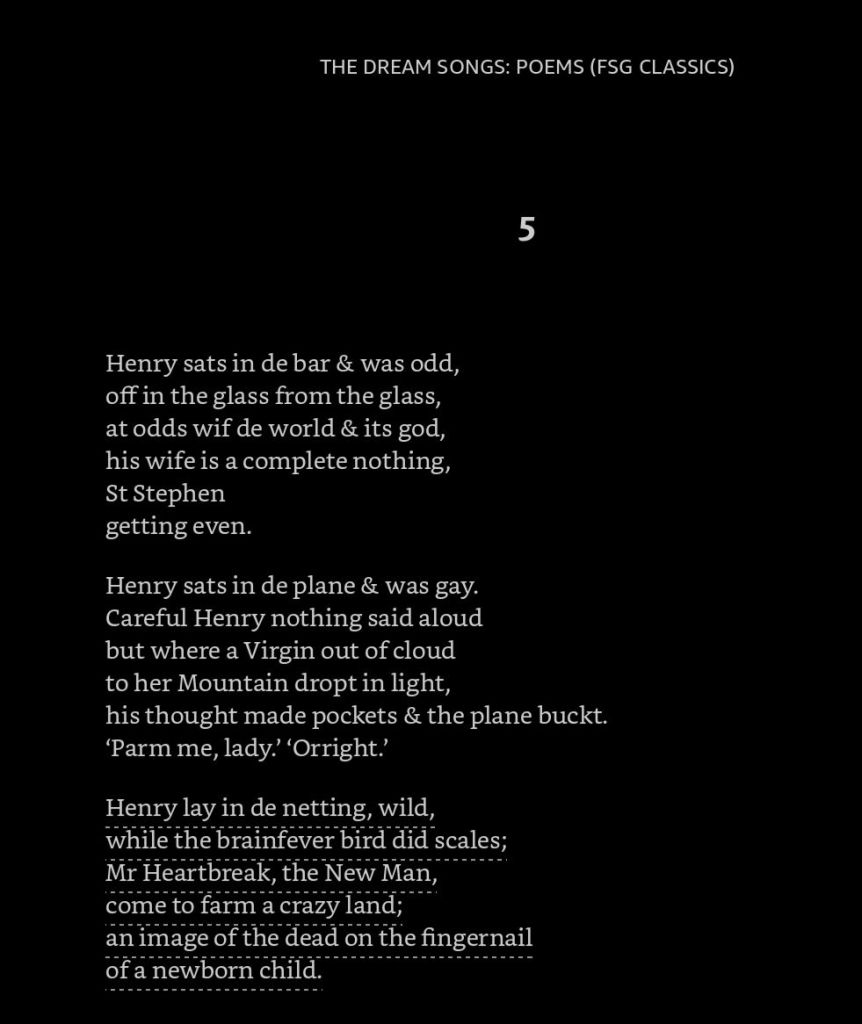
No it is not from the longer book from which I stole the title. The post title just fits the stolen stanzas. My lady partner (not my wife) is not “a complete nothing” although the image of another woman entering the scene, which I take to be the theme of the overall poem, is apt. I have always taken the last lines to suggest that the the new woman, the virgin of the second stanza, is much younger than poor Henry.
The lines “Henry lay in de netting, wild, / while the brainfever bird did scales; / Mr Heartbreak, the New Man, / come to farm a crazy land;” are what shot my hand up to the corner of the page to turn a dog ear and reach for a pencil to underline. Is there any better description of the burning of romantic infatuation, particularly if it involves wandering afield?
St Stephen getting even I believe is part of Berryman’s complicated idea of the suffering of an American poet as similar to the suffering of the Israelites and Jewish people in general. Poets are cultural anathema to he-man cowboy America, further threatened by the current pogrom against the learned.
That he is accused of “cultural appropriation” in this regard is yet another reason the poet is to me Saint John of Berryman. I consider the world my subject, and all of its parts mine to use as need arises. If you wish to go after me on that subject get back to me when you find some references to Rastafarians being accused of cultural appropriation for the same reason as Berryman. It is just yet another thing in the long bill of attainder currently come due against Berryman, and you will have the pry him out of my cold dead hands.
Don’t get me started about Mr Bones and minstrilry, a hill I am ever ready to die on. The selective, Stalinesque erasure of inconvenient bits of culture does nothing but sow confusion by taking away critical blocks from the bottom of the intricate Jenga of our complicated culture. Easier to ship the offenders off to the gulag than to confront our difficult, frequently awful history and Berryman’s complicated running conceit.


Leave a Reply